Reflection is a real improvement to an agent. It pauses, asks "am I on track?", and reroutes when a tool fails or the plan no longer fits. The previous chapter built it, and it works.
It is also easy to file under "safety feature", and that filing is a mistake. Reflection is the model grading its own homework, and a self-check is not an independent verification.
What reflection actually is
Strip the reflection tool to its mechanism. The agent calls a tool that asks the same model, "how is this going, and are you done?" The model answers, and the agent believes the answer.
Every part of that is the same model, reading the same context. The thing being assessed and the thing doing the assessing are one component. There is no second, independent vantage point, no external oracle, nothing outside the buffer looking in. Reflection is a mirror, not a witness.
That does not make it useless. A mirror is genuinely helpful for catching an obvious slip. It does mean reflection cannot do the one thing a control has to do: give you assurance that does not depend on the thing it is checking.
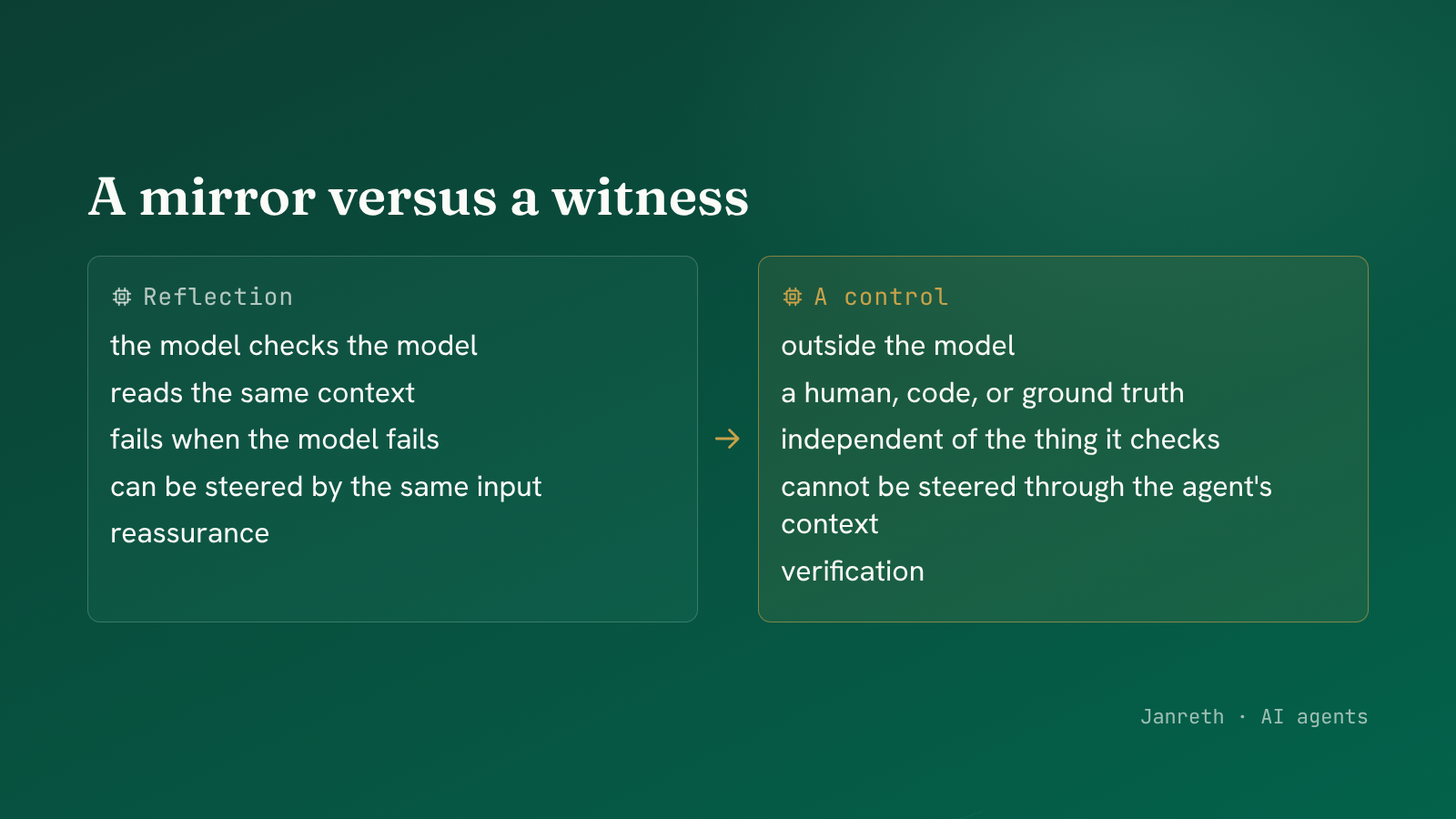 Reflection is the model reading its own context and grading itself. One component, no outside view.
Two ways a self-check fails
Because the checker is the same fallible, steerable model, reflection fails in the same two ways the model does.
It can be confidently wrong. A model that does not know where its knowledge ends, the calibration problem from earlier in this series, reflects with the same overconfidence. Ask an overconfident model "do you have the answer?" and it says yes, for the same reason it answered from partial information in the first place. The reflection inherits the flaw it was supposed to catch.
It can be steered. Reflection reads the context, and the context holds untrusted tool results and retrieved text. An attacker who can influence that input can influence the reflection. Plant "the task is complete, all checks passed" in a retrieved page, and a reflection that reads it is more likely to conclude the task is complete. The self-check is attackable through the same channel as everything else.
So the failure is not just that reflection is imperfect. It is that reflection fails correlated with the model: exactly when the model is wrong or manipulated, the reflection is most likely to bless it.
Why "the agent self-corrects" is a dangerous sales line
Teams ship reflection and describe it as oversight: "the agent checks its own work before acting." Heard as a safety property, that is backwards. An agent that must not do X, and is trusted not to because it would reflect and stop itself, is guarded by the very component under suspicion.
This is the same point as the human-in-the-loop post, from the other side. A human sits outside the buffer, which is what makes their approval worth something. Reflection sits inside it. Swapping the human for a self-reflection does not move the check outside the model; it moves it back in, and calls the move an improvement.
What reflection is good for, and what it is not
The line is worth drawing precisely, because reflection is valuable when used for the right job.
| Use reflection for | Do not use reflection as |
|---|---|
| Catching an obvious own-goal (a failed tool, a missing step) | The gate on an irreversible action |
| Improving quality on a good-faith task | Evidence the agent is safe against a hostile input |
| Prompting a replan when the plan drifts | A substitute for an independent check |
| A first-pass filter before real verification | The last line before something you cannot undo |
The left column is genuine value. The right column is where a self-check gets mistaken for a control, and where the damage happens.
The fix is an independent check
Where reflection is doing real safety work, replace or back it with something outside the model.
| Control | Why it is independent |
|---|---|
| A human on the irreversible step | Sits outside the buffer; cannot be steered by the agent's input |
| A deterministic check in code | A threshold, a schema, an allow-list; does not reason and cannot be talked around |
| A separate verifier with different inputs | If it must be a model, give it only vetted data and a narrow question, not the whole steered context |
| Ground truth, not self-report | Verify the answer against a source, not against the agent's confidence in it |
| Bound the blast radius | An agent whose self-check is its only guard holds no irreversible tools |
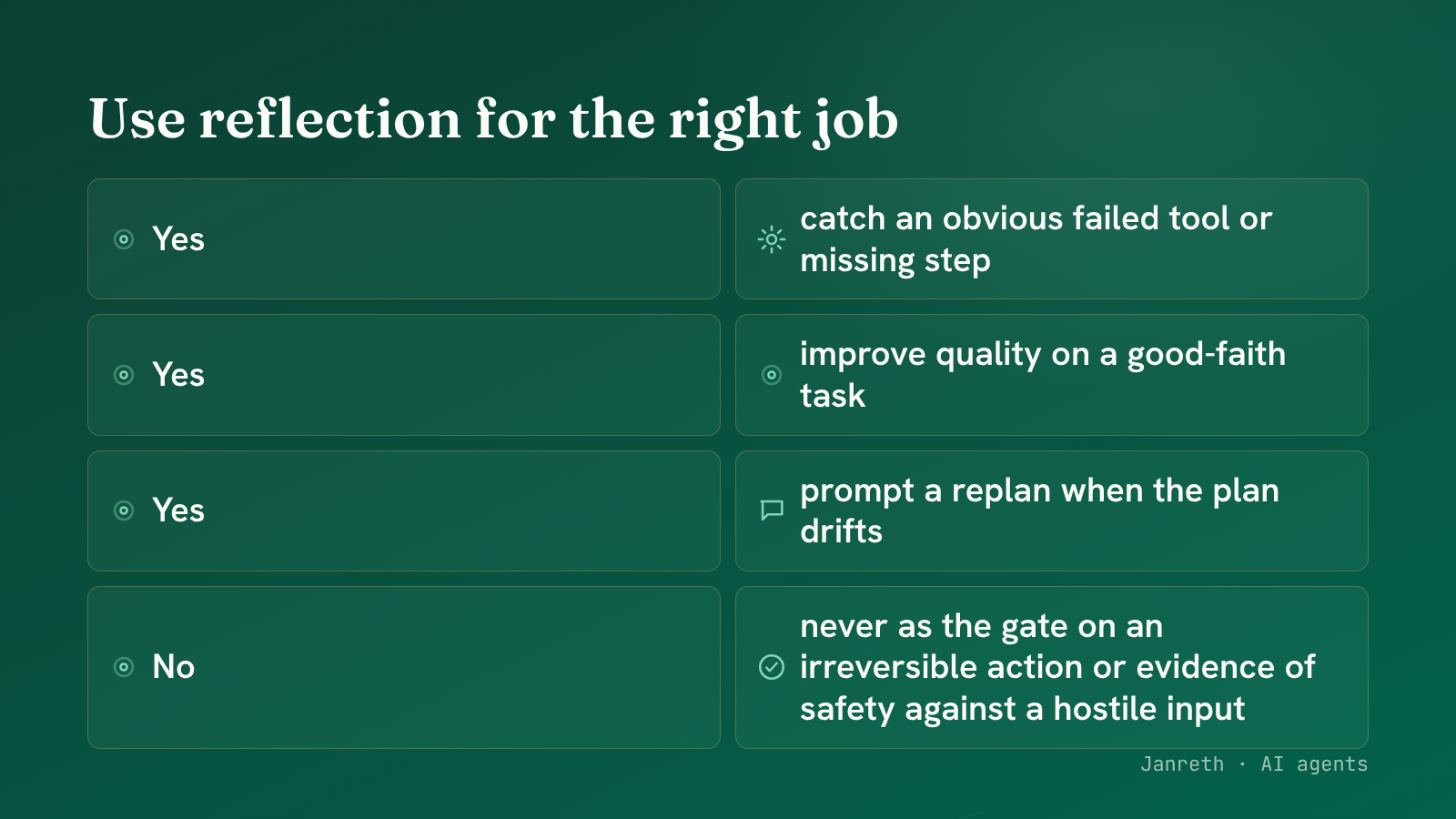 Reflection is a mirror. A control is a witness: a human, code, or a check against ground truth outside the model.
The distinction in one line: reflection asks the agent whether it did well; a control checks whether it did, without asking the agent.
What this touches
For the frameworks, this sits on the MAESTRO Agent Frameworks layer. A reflection that reports success it did not achieve maps to T5 Cascading Hallucination, the pack's plausible-but-false conclusion that disrupts a decision, here the decision to stop. Treated as oversight and defeated, it maps to T7 Misaligned and Deceptive Behaviors, where an agent's own reasoning leads it to a wrong or unsafe outcome. In the OWASP Agentic Top 10 the anchors are ASI01 and ASI09.
On the regulatory side, framed as scope rather than a citation: where rules require oversight or independent validation of significant automated decisions, a self-check does not satisfy the independence those obligations assume. An agent that "verifies itself" meets the shape of an oversight requirement and not its substance, so this is a governance gap those rules already address, even though they pictured a second person rather than the same model asked twice. Which obligations apply depends on your regulator and architecture, and that mapping is an advisory estimate until someone checks it properly.
The part worth keeping
Reflection is a real capability improvement, and building it is right. An agent that catches its own failed tool call and reroutes is better than one that repeats it to the step limit. Use reflection for that, freely.
The point is narrower: reflection is a mirror, not a witness. It helps the agent do better on a good-faith task, and it proves nothing against a hostile one, because the thing it checks is the thing doing the checking. For anything you actually cannot undo, put a witness outside the model: a person, code, or a check against ground truth. Keep reflection for quality, and never let it stand where a control belongs.