Ask a chatbot with a search tool what the weather is in Dubai, and a well-behaved one might reply: "Would you like me to search for that?"
The answer is polite, and the answer is a failure. You asked for the weather. The chatbot handed the work back and asked you to authorise the obvious.
Closing that gap is the whole of agent prompt design, and most people skip it because a prompt looks like a prompt.
The difference in one line
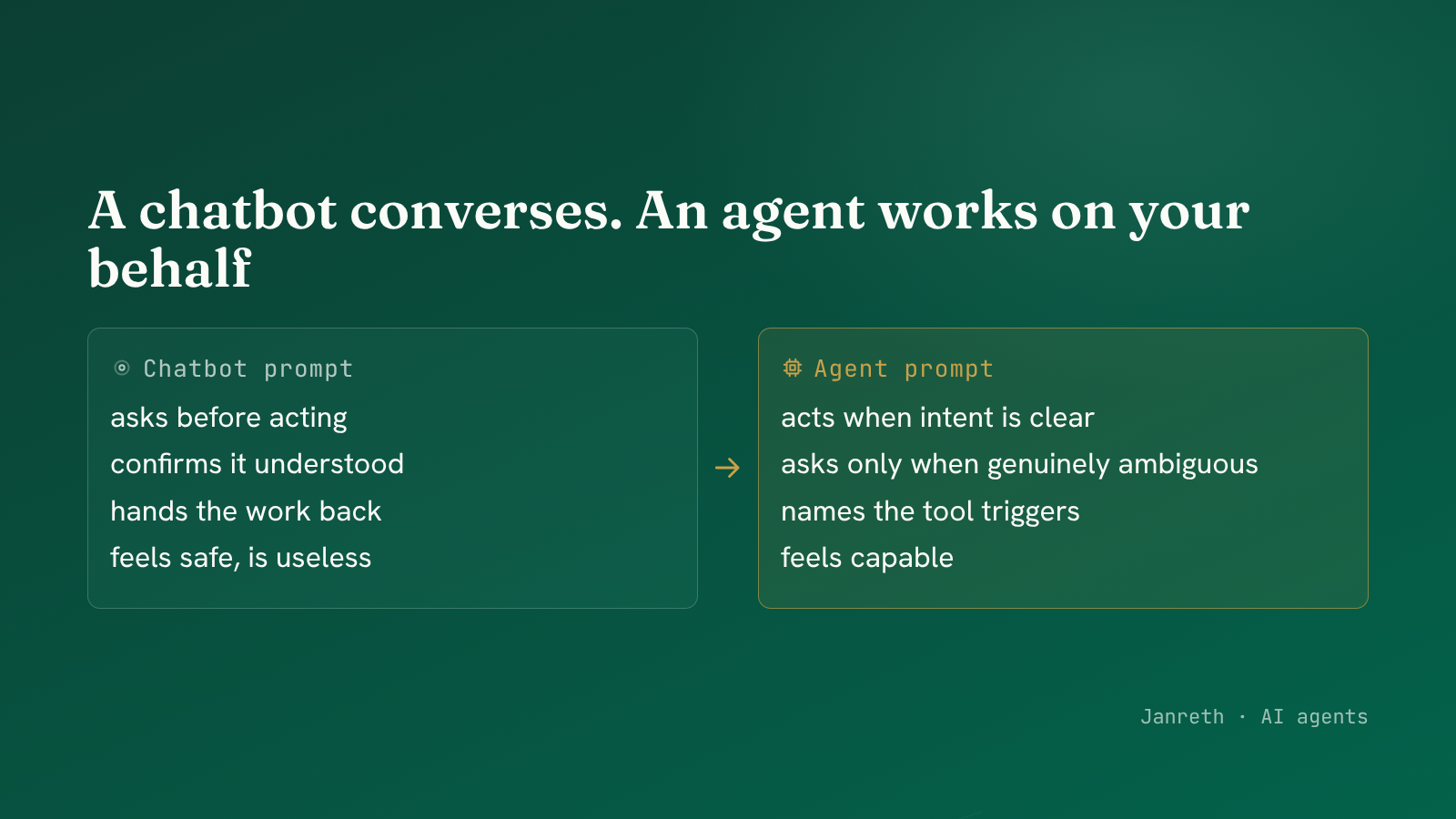
A chatbot converses with you. An agent works on your behalf. Every rule below follows from that one difference.
The rule worth memorising is short: when the request is clear, act on it. When the request is ambiguous, ask.
In a system prompt that becomes two lines:
When the user's intent is clear, execute immediately without confirmation.
Only when intent is unclear, ask minimal questions to clarify.
Two sentences. The first line makes it an agent. The second line keeps it from charging off in the wrong direction when a request genuinely is unclear.
Many first agents feel useless for this exact reason. They carry a chatbot's prompt, so they check in constantly, and an assistant that checks in constantly looks the same as one doing no work at all.
Vague instructions produce vague behaviour
The second half of agent prompting covers tool use, and it turns out to be more practical than it first looks.
"Use tools when necessary" reads like an instruction, and it restates the problem. The word necessary names the exact judgement you were trying to specify, so the sentence hands that judgement straight back to the model.
Compare:
| Vague | Specific |
|---|---|
| Use tools when necessary | Use proactively, without asking permission |
| Search if you need current information | For rapidly changing information such as prices or breaking news, search immediately |
| Check facts where appropriate | For slower-changing topics, always search if the question asks about current status |
The right column runs longer, and the length is the price. You sit closer to the business than the model does, so you decide once, in writing, what counts as fast-moving information.
 Vague instructions hand the judgement back to the model.
Trigger patterns: the part nobody writes down
A more direct technique exists, and it gets written down far less often than it deserves. The technique replaces an abstract description of when a tool applies with a concrete list of the phrasings that should fire it. For the ticket agent we have been building toward:
Read the ticket export when you see expressions like these:
  Explicit references:  "in the export", "from last quarter's tickets"
  Time references:      "last quarter", "since April", "this year so far"
  Implicit signals:     "our volume", "the routine ones", "how many of those"
The third line carries the most value. "The routine ones" reads like ordinary speech, with no question mark and no mention of a file. The phrase assumes a shared context that exists only inside your data, which makes it the exact moment the export should be read, and the exact case a general instruction misses.
The practical version: before you build the agent, write down how people actually phrase the situations that need each tool. Collect their words, in their wording.
What these three techniques share
Each technique settles a different question in advance.
The default attitude settles the posture. Trigger patterns settle the timing. The ambiguity rule settles the exception.
Together they move judgement out of the moment and into the design, which is the entire job. An agent decides at runtime, in context you cannot see, at a speed you cannot supervise. The prompt is your one chance to settle anything before that happens.
Prompt quality carries more weight in agent work than in chat for the same reason. A mediocre chatbot prompt produces a mediocre answer that you read and correct. A mediocre agent prompt produces a confident sequence of actions.
The honest caveat
Everything above makes an agent more capable and more autonomous, which is the right goal. An agent that asks permission at every step does the work twice, once by the model and once by you.
Read the line at the centre of it again: execute immediately without confirmation.
The line is correct engineering advice. The same line carries real consequences the moment the agent holds a tool that does something you cannot undo, because the safety net gates on ambiguity rather than on damage.
What to take from this
- A chatbot converses and an agent acts, and the system prompt is where you write that difference down.
- Specific instructions beat general ones, because a general one hands the judgement back to the model.
- List the phrasings that should fire each tool, in the wording your users actually use.
A good prompt shapes how the agent behaves. Knowing whether the agent is any good at the job needs something else entirely: a fixed set of questions, and a way to score the answers.